SimpluMed.ro
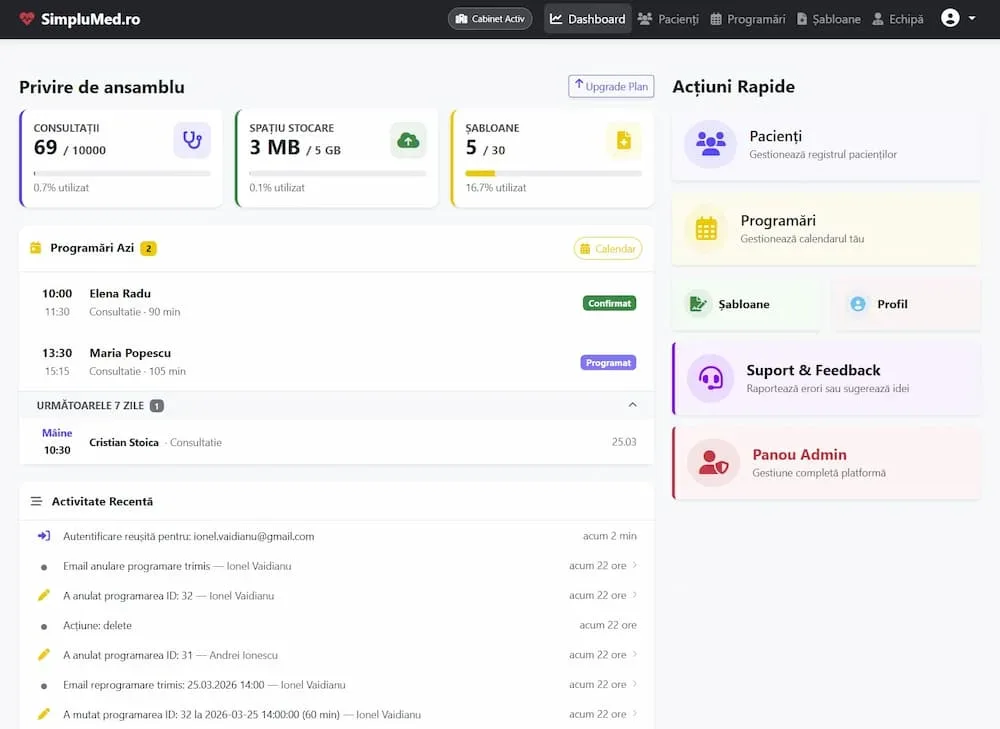
A web platform for medical practices: patient records, consultations and documents in one place, with encrypted data and a full audit trail. Written from scratch, from the database schema up to the interface.
- Year
- 2025
- Built with
- PHP, MariaDB, JavaScript, CSS
A small medical practice keeps its records in a paper diary, a handful of Word files and a few spreadsheets, scattered across the computers in the office. That works until a doctor starts seeing patients in two places, until someone has to produce a patient's complete history on request, or until a file gets deleted by accident.
SimpluMed pulls all of it into one web application: a patient record with the full consultation history, specialty-specific consultation templates, documents and subscription tracking — all in the browser, with nothing to install.
What it does
- a patient record holding the complete consultation history, built from sections that can be added one at a time
- consultation templates configurable per specialty, with fields that appear only when an earlier answer calls for them
- several practices under one account, with doctors free to work in any of them
- subscription plans with consultation and storage limits, tracked as they are used
- an activity log for every operation on patient data
How it is built
Sensitive data is encrypted in the database. Encrypting the connection to the server is not enough: if someone gets hold of a copy of the database, the identifying fields have to say nothing. Field-level encryption has a cost you pay at search time, and that changes how the queries are written — better decided at the start than repaired later.
A patient belongs to the practice, not to the doctor. The first version tied patient access to the doctor's current practice. When a doctor moved, their patients vanished from the list. A direct link between patient and practice is both the legally sound answer and the easier one to follow in code.
Consultation forms are data, not code. A template holds its fields, groups and conditions in the database. A new specialty means a new template, not a hand-written form and another branch through the code.
The panel extends by adding files, not by editing configuration. Sections in the admin panel and cards in the patient record discover themselves from the folder: a new file means a new section, with nothing to register anywhere.
On the security side: a token on every form, prepared statements throughout, ownership checked before any operation on data, and escaping on output. Nothing exotic — just applied consistently, everywhere.
Why it matters
Medical data does not forgive shortcuts. Every decision above started from "what happens if someone reaches the database" and "what happens when a patient asks for everything you hold on them", rather than from what was quickest to write.